- MAIN PAGE
- – elvtr magazine – The Gamer Effect
The Gamer Effect
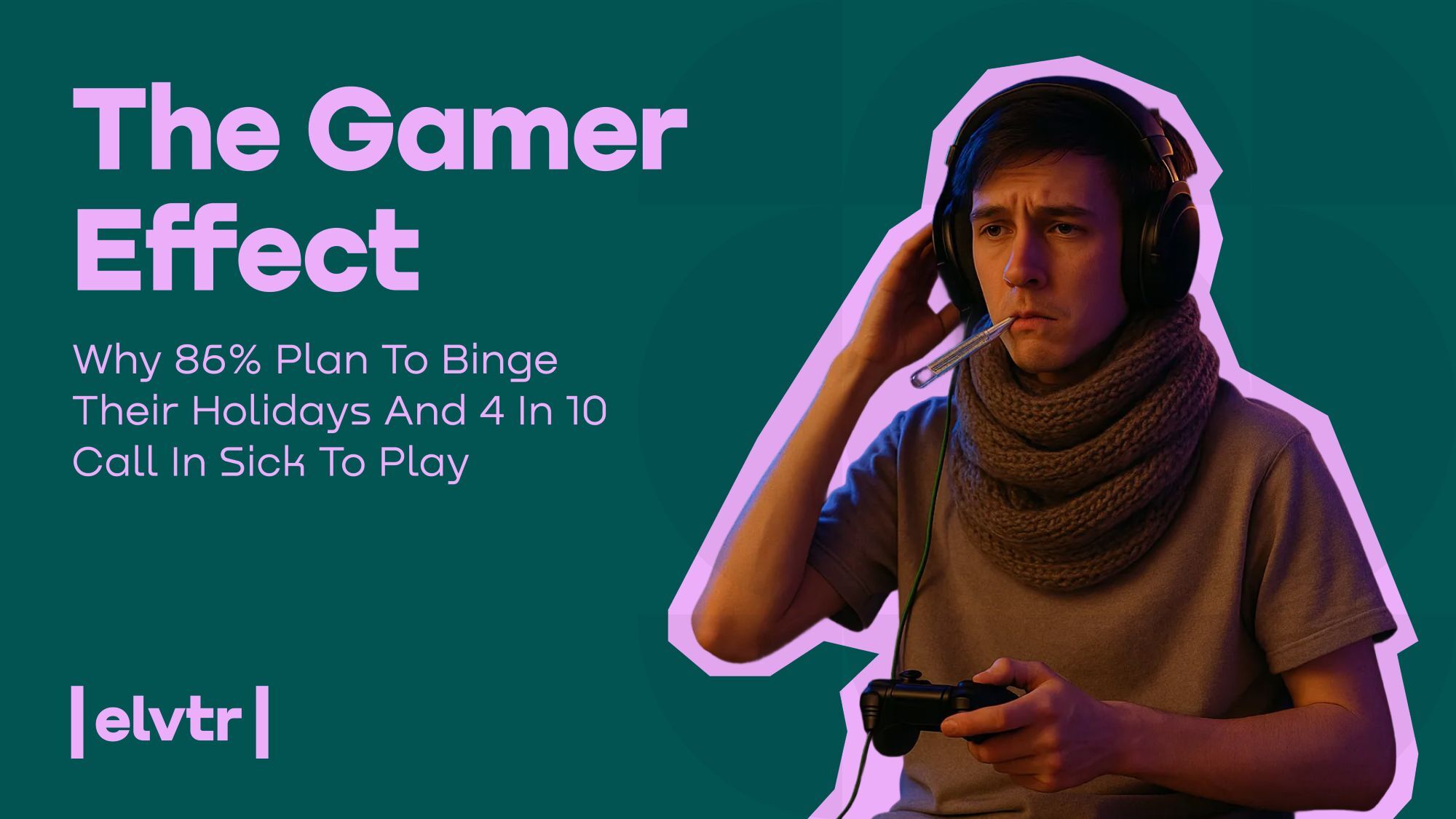
In a new ELVTR survey of 1000 respondents, nearly 4 in 10 say they have called in sick or taken time off work primarily to play games. Another 58% report that they have spent at least one Christmas or New Year’s Eve playing instead of celebrating.
At the same time, 72% say gaming makes them feel calmer or happier, 71% say it helps them cope with anxiety or depression, and 69% credit games with boosting creativity. This is not a simple “games are bad” story. It is a story about a medium that has become the primary screen for many people, delivering real emotional benefits while quietly rebalancing how they spend time, money, and holidays.
External research suggests that for Gen Z, video games now take more weekly hours than TV, with Newzoo estimating just over 12 hours per week on games, slightly more than television, and almost on par with social media. In other words, games are not a niche pastime. They are a core competitor in the attention economy.
This ELVTR “Gamer Effect” survey offers a granular look at how that attention translates into tradeoffs in love, work, money, and mental health.
Methodology
ELVTR fielded an online survey in early December 2025, yielding 1000 valid responses. The sample is heavily skewed toward gamers: 96% self-identify as gamers, and 72% of them describe themselves as people who “play regularly.” This is a self-selected, gamer-heavy sample rather than a census of the general population, so the findings are best read as a profile of engaged players, not “average citizens.”
We constructed a simple Risk Profile Score by summing seven binary behaviors: skipped showers to keep playing, skipped dates or sex to play, relationship damaged by gaming, called in sick to game, played during work hours, delayed essentials to buy games, and playing through major holidays instead of celebrating. A score of 0–1 is “low risk,” 2–3 is “moderate,” and 4 or more is “high risk.”
Among gamers, 26% fall into the high-risk bucket, 39% are moderate, and 35% are low risk.
The Cost of Play: Work, Money, And Calling In Sick
Calling in sick for games is normalised
Among people who answered the work question:
- 39% say they have called in sick or taken time off work to play at least once.
- That breaks down into 32% “yes, once or twice” and 7% “yes, many times.”
Intensity matters:
- Among regular gamers, 43% have called in sick to play.
- Among casual gamers, that figure is 27%.
This gap is statistically significant at conventional levels, which means it is very unlikely to be a fluke in this sample. In practical terms, high-intensity gamers are meaningfully more likely to treat paid work as negotiable when a game session or release really matters.
Playing at work is common, but the intensity gap is smaller
Asked whether they play during work hours:
- 39% say they play “sometimes” on the job.
- 61% say they never do.
Among regular gamers, 41% admit to playing during work hours vs 31% of casual gamers. The difference points in the expected direction, but in this dataset, it is more of a directional pattern than a statistically airtight divide.
Money tradeoffs: games vs essentials
On financial strain, respondents were asked if they had ever had to choose between paying for essentials and buying a video game:
- 28% say yes (once or more).
- 72% say never.
This is framed as an allocation problem, not a morality play: a quarter of this gamer-heavy sample has at some point pushed necessities to the edge to make room for gaming spend, in a world where Newzoo and others estimate that the average gamer already spends significant time and cash on games and virtual worlds every week.
High-risk gamers lean harder toward gaming careers
Career intent is where the risk profile really sharpens. When asked whether they have considered quitting their current job to pursue gaming professionally:
- 45% say “no, gaming is just a hobby.”
- 45% say “yes, working in game development or production is my dream.”
- 10% say “yes, as a full-time streamer or pro gamer.”
Among those who say gaming is “just a hobby,” only 17% are in the high-risk bucket. Among those dreaming of game development, 33% are high risk. For the smaller group aiming to be full-time streamers or pro players, about 35% are high risk.
Statistically, the link between risk profile and gaming-career ambition is strong. The most intense players are more likely to be both deeply invested in games as a medium and willing to accept real-world tradeoffs to stay close to it.
Love In The Lobby: Attraction, Partner Preferences, And Breakups
Gamers are more likely to see gamers as hot
On the basic attraction question:
- 51% say “yes, gamers are hot”
- 43% say they are neutral
- 6% say “no”
Among regular gamers:
- 58% say gamers are hot
- 35% of casual gamers
Most gamers want gamer partners
When asked whether they want their romantic partner to be a gamer:
- 12% say “yes, it is a must”
- 60% say “yes, it would be nice”
- 28% say “no, not important at all”
One respondent calls being a gamer a turn-off. Taken together 72% of respondents who answered want their partner to be a gamer or are at least positively inclined to the idea
Intensity again changes the shape:
- For regular gamers, 74% say it is either a must or would be nice for their partner to be a gamer, and 13% say it is non-negotiable
- For casual gamers, 67% want a gamer partner, and 7% call it a must
The stereotype of the isolated gamer does not match this dataset. High-intensity players are more likely to want their romantic life to be anchored in games too.
Skipped dates and relationship damage
On the sharper end of the romance spectrum:
- 26% of respondents say they have skipped a romantic date or chance for sex to play at least once
- 19% say “sometimes”
- 7% say “yes, many times”
- 6% report that a relationship ended because of gaming, split between:
- “I left them because they played too much”
- “They left me because I played too much”
- “We both played too much and it caused fights”
Those absolute Ns on breakups are small, so this is best read as a tail risk, not a defining feature of gamer relationships. Most respondents have not lost a relationship over games, but a visible minority has, and they are more concentrated among gamers than among the few non-gamers in the sample.


When Play Bites Back: Hygiene, Burnout, Toxicity, Holidays
Hygiene and holidays are the first casualties
On the everyday side, gaming is clearly winning some battles against basic routines:
- 43% have skipped or delayed a shower during extended gaming sessions at least sometimes. Among regular gamers, 45%. Among casual gamers, 40%.
- 58% have played through Christmas or New Year’s Eve instead of celebrating at least once. Among regular gamers, 62%. Among casual gamers, 45%
Looking ahead, this is not just about past behavior. Asked how they plan to spend the upcoming holidays:
- 72% say they will binge on games “for a few days here and there”
- 14% say they are going “full marathon mode the whole break”
- 14% plan to “mostly take a break from gaming”
Holidays have become a major ritual window for intensive play. Where earlier generations built traditions around TV marathons or film trilogies, this cohort is building them around raids, battle passes, and seasonal events.
Burnout is concentrated among stress gamers
Gaming burnout is not rare:
- 56% say they “sometimes” feel burned out
- 5% say they “often” feel that way
- 38% say “never”
Triggers matter. Using the multi-select question “When do you tend to play the most?” we created two groups among gamers:
- Stress players: those who play when stressed or tired, angry, lonely, or procrastinating from responsibilities
- Happy-only players: those who play when they are happy or just whenever they get the chance, but did not select any stress-related trigger
Among stress players:
- 8% report “often” feeling gaming burnout
- 59% say “sometimes”
Among happy-only players:
- 1% report “often” feeling burnout
- 50% say “sometimes”
- 49% say “never”
The difference in “often burned out” rates is statistically significant. It aligns with broader research on screen time, which finds that negative consequences, not heavy involvement alone, drive most health outcomes for both gaming and social media. High-intensity play that is primarily an escape from stress looks quite different from high-intensity play that is primarily joyful.
Online toxicity and anxiety
Asked whether they have developed anxiety from repeated verbal abuse while gaming:
- 81% say no
- 15% say “somewhat”
- 3% say yes
The burden is not evenly distributed. Among gamers in the high-risk group, 28% report abuse-linked anxiety. Among low-risk gamers, 10%.
The survey does not measure gender or platform mix, so it cannot pinpoint whether this is driven by particular game genres or demographics. It does, however, support external work showing that social feeds and online spaces can be emotionally harsher than even intensive gaming sessions, especially for younger users.
The Upside Of Play: Calm, Coping, Creativity, Community
If all you read were the risk numbers, you might imagine a grim picture. The positive side of the ledger is just as striking.
The survey asked: “What positive effects does gaming have on you?” Respondents could tick as many as applied:
- 72% say gaming “makes me feel calmer or happier.”
- 71% say it “helps me cope with anxiety or depression.”
- 69% say it “encourages creativity.”
- 59% say it “helps me connect with friends or meet new people.”
- 55% say it “improves focus and concentration.”
- 24% say it “makes me feel more confident.”
Respondents select an average of 3 positive effects each. Only about 3% explicitly chose “doesn’t really affect me” and no other positive effect.
Interestingly, the high-risk gamers are not people who get nothing from games. They tend to get more:
- 55% of high-risk gamers check 4 or more positive effects, compared with 37% of low-risk gamers
- 79% of high-risk gamers say games help them cope with anxiety or depression, versus 56% of low-risk gamers
For many high-intensity gamers, this is not just consumption. It is a multi-purpose tool for mood regulation, creativity, and social connection. External time-use studies back this up: across many markets, people now spend roughly as many or more hours per week in games and virtual worlds as they do on written media and even some streaming categories, especially in younger cohorts. Games are doing a job that TV, film, and even social feeds used to do on their own.
Gamers As Power Users Of The Attention Economy
A quarter of gamers sit in the high-risk tail
Using the composite Risk Profile Score, among gamers only:
- 26% are high risk (score 4 or more)
- 39% are moderate risk (score 2–3)
- 35% are low risk
Risky behaviors are defined as ever doing each of the following:
- Skipping showers to keep playing (43%)
- Skipping dates or sex to play (26%)
- Calling in sick or taking time off to play (39%)
- Playing during work hours (39%)
- Delaying essentials like rent or bills to buy games (28%)
- Playing through Christmas or New Year’s instead of celebrating at least once (58%)
- Having a relationship end because of gaming (6%, a smaller but non-trivial tail)
The data make clear that most gamers are not train wrecks. Roughly one-third sit in the low-risk group despite heavy engagement, and many report strong positive effects with limited downside. The industry is dealing with a classic power law: a relatively small, intense tail of users drives disproportionate hours, spending, and risk.
High-risk gamers are also the most deeply invested in gaming careers
That same high-risk tail is where the most ambitious gaming career plans live.
Among the three career-intent groups:
- Hobby-only: High risk 17%
- Game development dream: High risk 33%
- Streamer/pro dream: High risk 35%
The association between risk level and career ambition is statistically strong. The gamers most likely to bend work, holidays, and hygiene around play are also the ones most likely to want to make games or perform them for a living.
For studios, platforms, and education providers, this is both an opportunity and a responsibility. These are the users who will spend 10, 20, or 30 hours a week inside your game or community, in a world where global averages for regular gamers already run in that direction. They are also the ones who are most exposed to burnout, financial tradeoffs, and social friction.
So What: Implications For Industry, Employers, And Platforms
For game studios and publishers
- Holiday calendars are real infrastructure. With 86% of respondents planning at least some binge gaming over the holidays and 14% going “full marathon mode,” seasonal events and releases are no longer just marketing beats. They function like cultural fixtures, competing with travel, TV, and family rituals.
- Design decisions echo in risk metrics. Games that lean heavily on streak mechanics, FOMO-driven events, or social pressure to stay online will bias players toward exactly the behaviors that show up in the high-risk bucket: calling in sick, skipping holidays, and treating essentials as optional.
For employers and HR leaders
- Gaming is part of the mental health stack. 71% of respondents say games help them cope with anxiety or depression, and 72% say they feel calmer or happier after playing. For many workers, a two-hour gaming session fills the role that TV, books, or gym time once did after work.
- But boundaries are blurry. With 39% of respondents admitting to calling in sick to play and 39% playing during work hours, employers should treat gaming the way they treated social media ten years ago: as a fact of life that needs clear norms, not as a curiosity.
For platforms and regulators
- Toxicity still matters. About 18% of respondents report anxiety linked to verbal abuse while gaming, and the rate is higher in the high-risk group. That points to moderation and community design, not just individual self-control.
- Attention saturation is real. External data suggests that Gen Z now spends more weekly hours on games and social media than on TV or reading. Gaming does not sit outside the attention economy; it is a central player.
Conclusion: Gaming As The Latest Dominant Medium
Taken together, the ELVTR Gamer Effect survey and external benchmarks point to a clear conclusion:
- Games have become a dominant medium, sitting alongside social platforms as the primary competitor for human attention
- Most gamers extract real value from that attention in the form of calm, coping, creativity, and community
- A meaningful minority pays real costs, in work performance, money, hygiene, romance, and holiday rituals
For the industry, the challenge is not to treat high-intensity gamers as problems, but as power users whose behaviors reveal where the medium is going next. For employers and educators, the question is how to design work and learning that can coexist with a medium that asks for hours, not minutes, of focused engagement.
And for everyone else watching gaming from the outside, the data makes one thing clear: whatever you think of gamers, they are not sitting in the margins of culture. They are in the middle of it, reshaping how love, work, and holidays actually play out, one raid, ranked match, and farming session at a time.